September 2026
Introducing Marqab: Your Product Portfolio, Answered
Every company that ships more than a couple of products eventually hits the same wall. There is a spreadsheet somewhere that lists them all. It was accurate the week someone made it. Since then, owners have changed teams, target dates have slipped, a component was split in two, and nobody is quite sure whether the billing service still depends on the old auth API.
Today we are launching Marqab, a product-portfolio tracker for teams. It gives you one place to see every product and component, who owns it, where it is on the roadmap, how healthy it is, what shipped recently, and what else would break if it went down.
The problem: portfolio sprawl
We build and run several products at Arvyo, and we also help clients run theirs. The questions we kept asking were rarely hard, but they were always slow to answer. Who owns this? Is it on track for the date we promised? What shipped last week? If this service has an outage, which products and teams are affected?
The answers usually existed, just scattered across GitHub, Jira, Slack threads, an incident channel and somebody’s memory. Pulling them together meant asking around, and by the time you had a picture, it was already out of date. Status spreadsheets try to fix this, but they depend on people updating them by hand, which is exactly the work that gets dropped when a team is busy.
What Marqab does
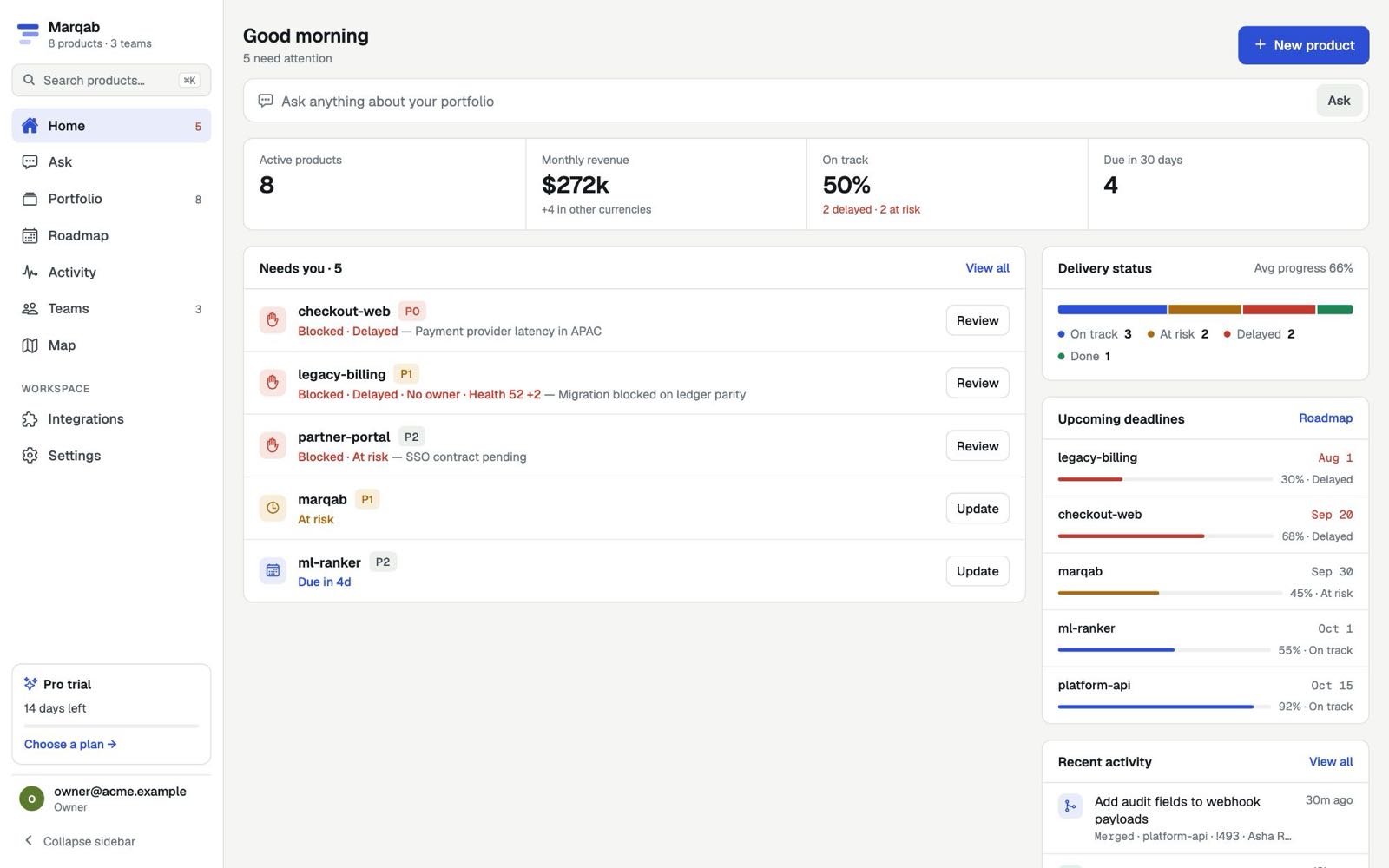
Marqab keeps a living record of your portfolio. Each product has an owner and team, lifecycle and priority, progress and target date, revenue, website and health, and it can be broken down into components. The Portfolio view puts all of it in one sortable, searchable table.
Home is a queue of what needs attention: products that are blocked, delayed, unowned or unhealthy come first, with the reason and a suggested next action. The Roadmap shows timeline, list and board views, grouped by team, status, priority or owner, so it is easy to see what is late or due soon.
The Map shows how products and components depend on each other. Pick one and Marqab highlights everything downstream, how many teams that touches and how much revenue rides on it. That is the view you want open during an incident, not after it.
How it works
You can add products by hand or import them from a spreadsheet as CSV or JSON. Then connect the tools your teams already use. GitHub and GitLab bring in merged pull requests, merge requests and releases. Jira brings in closed tickets. Sentry brings in error and health signals. Slack is where updates can be posted and where you can message an owner directly.
As that activity flows in, Marqab rolls it into per-product digests and release notes, with health trends and incidents alongside. Nobody has to remember to update a status field for the picture to stay current.
Ask sits on top of all of this. You type a question in plain language, such as who owns checkout, what is delayed this month, or what breaks if platform-api goes down, and Marqab computes the answer from your workspace data. It is not a chatbot guessing at a reply: every answer shows what it was based on, and if Ask cannot answer something it says so and suggests questions it can.
Web, iOS and Android
Marqab runs as a web dashboard at dash.marqab.dev, with a desktop layout built around a sidebar, keyboard shortcuts and wide tables. The iPhone and Android apps use a phone layout with tabs, large touch targets and a pinch-to-zoom map, so you can check on a product or ask a question away from your desk. You can sign in with an email code, Google or Microsoft.
Pricing and the free trial
Every workspace starts with a 14-day free trial, and no card is required. After that there are four plans: Pro at $49 per month with 10 seats, Startup at $149 per month with 20 seats, Business at $249 per month with 30 seats, and Enterprise with custom pricing, more seats and terms by agreement. Paying yearly saves 30%. Checkout is handled by Lemon Squeezy as our merchant of record.
Your data stays yours. You can export the whole portfolio as JSON, or each table as CSV, at any time, including after a trial ends.
What’s next
Marqab is new, and we are shaping it with the teams who use it. We are working on deeper integrations, more of the questions Ask can answer, and faster setup for larger portfolios. If there is a tool you want connected or a question you wish Ask could answer, tell us; that feedback directly shapes what we build.
You can read more on the Marqab page here on arvyo.com, see full plan details at marqab.dev, or start a free trial at dash.marqab.dev. Marqab is built by Arvyo Limited in Dhaka, Bangladesh.